E1. Hydrogen (P1)
Hydrogen
| Topics - H+ and H- ions - Isotopes of hydrogen - Hydrogen gas - Polar and nonpolar E-H bonds (P2) - Hydrogen bonding (P2) - Binary hydrides (P2) |  |
|---|
1.1 Introduction
Hydrogen
- Atomic number 1
- Atomic weight 1.008
- Electron configuration 1s1
Hydrogen is the lightest and most abundant chemical element in the universe, accounting for about 75% of all ordinary matter
The simplest atom: 1 proton + 1 electron
1.2 The H+ and H- Ions
The H+ ion (proton)
The ionization energy of a hydrogen atom is 1312 kJ·mol-1 Clearly, protons cannot exist under ordinary conditions. Therefore, H+ in water exists mainly in forms such as
Hydration of the proton is strongly exothermic
The ion is a well-defined species and has been crystallographically characterized in various salts (fig. 1/2)
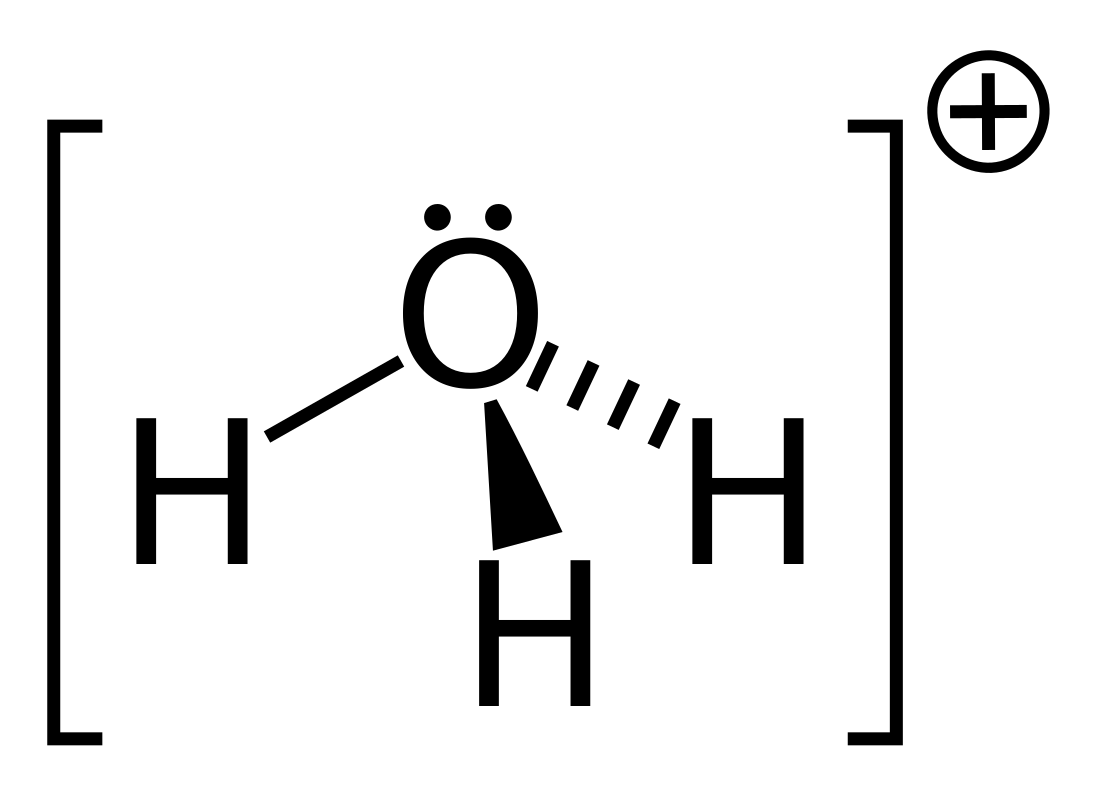
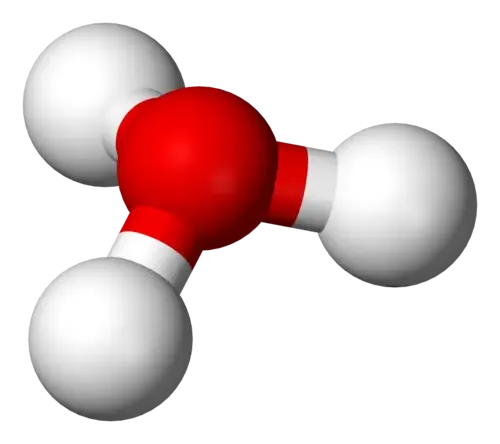
The and ions have also been isolated in crystalline acid hydrates (fig. 3)
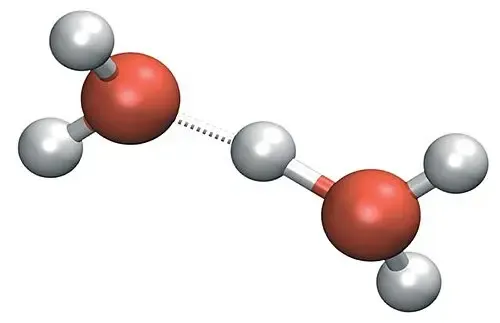
The and ions are also common members of the hydrated proton family. Hydrated protons are species of the form
The H- ion
The electron affinity of a hydrogen atom is
All alkali-metal hydrides have the NaCl crystal structure
Based on diffraction data and the radii of the metal ions, the radius of the H- ion ranges from 154 pm (LiH) to 133 pm (CsH), with an average value close to the 133 pm radius of F-
The atomic radius increases substantially from an H atom ( ) to an H- ion. This is due to the interelectronic repulsion produced when the second electron enters the 1s atomic orbital
The relatively small hydride-ion radius in LiH gives the Li-H bond some covalent character. However, the calculated and experimental lattice energies of Group 1 metal hydrides show that the electrostatic model applies to every first-group metal hydride
The hydrides of s-block metals (except Be) can be prepared by heating H2 with the metal
Ionic hydrides tend to decompose into their constituent elements. At the same time, salts of ionic hydrides with metals in high oxidation states are the least likely to exist
(See Note 2 for details)
1.3 Isotopes of Hydrogen
Deuterium
The differences between H and D, or between H2O and D2O, arise from their different masses. These mass differences in turn affect their fundamental vibrational wavenumbers and zero-point energies (see the example problem)
The fundamental vibrational frequencies of H2, HD, and D2 are 4159, 3630, and 2990 cm-1, respectively. The calculated zero-point energies of H2 and D2 are 26.0 and 18.4 kJ·mol-1, respectively
These molecules have identical total electronic binding energies, so their dissociation energies differ by
The D-D bond is stronger than the H-H bond
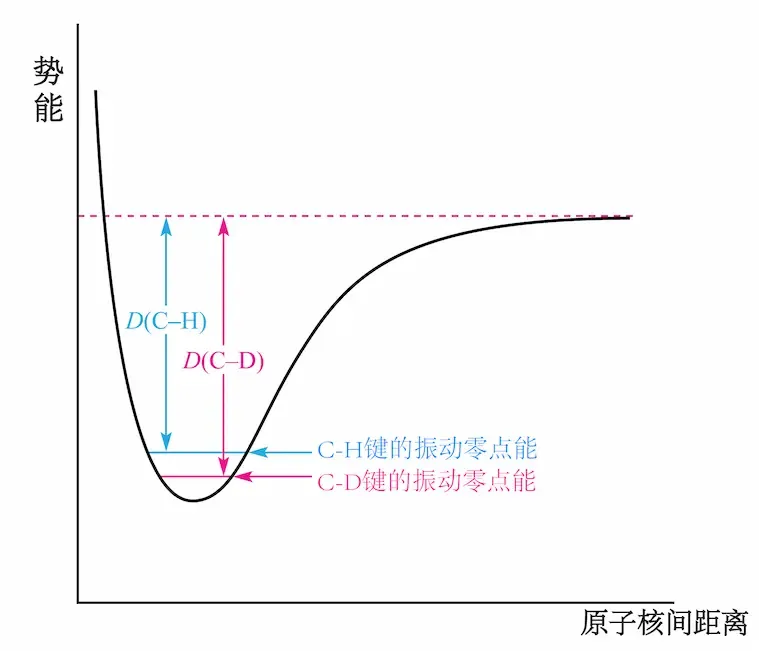
As shown in fig. 4, an R-D bond is also stronger than the corresponding R-H bond. This difference is the basis of the kinetic isotope effect
Example
49th IChO
Question 2: Kinetic Isotope Effect (KIE) and Zero-Point Vibrational Energy (ZPE)
Calculating ZPE and KIE
The kinetic isotope effect (KIE) is the change in a reaction rate constant that occurs when an atom in a reactant molecule is replaced by one of its isotopes. The KIE can be used to identify the cleavage of a specific bond to hydrogen during a reaction. The harmonic oscillator model is commonly used to estimate the difference between the activation rates of C-H and C-D bonds.
The vibrational frequency ( ) in the harmonic oscillator model can be expressed as:
Here, k is the force constant and is the reduced mass.
The vibrational energy of a molecule is:
Here, n is the vibrational quantum number and can take the values 0, 1, 2, 3, … The energy of the lowest vibrational energy level (n = 0) is called the zero-point vibrational energy (ZPE).
2-A1) Calculate the reduced masses of C-H ( ) and C-D ( ) in atomic mass units, assuming that the mass of deuterium is twice that of hydrogen
Solution
The reduced mass is the equivalent mass in a two-body problem and is calculated as
For this problem
Note that the unit is the atomic mass unit (amu)
2-A2) Assuming that the force constants (k) of the C-H and C-D stretching vibrations are the same and that the C-H stretching frequency is 2900 , calculate the C-D stretching frequency (in )
Solution
Substitute the values, taking care with the units
Thus,
2-A3) Using the C-H and C-D stretching frequencies from 2-A2), calculate the zero-point energies (ZPE) of the C-H and C-D stretching vibrations (in )
Solution
Again, substitute the values, taking care with the units
Kinetic Isotope Effect (KIE) Because the zero-point vibrational energies differ, a compound and its corresponding deuterated compound can be expected to react at different rates. For C-H and C-D bond-cleavage reactions, their transition-state energies are identical, as are their product energies. Thus, the isotope effect depends on the difference between the ZPE values of C-H and C-D.
2-A4) Calculate the difference between the bond dissociation energies (BDE) of the C-H and C-D bonds (BDECD - BDECH), in
Solution
Simply subtract
2-A5) Assuming that the activation energies ( ) for C-H and C-D bond cleavage are approximately equal to their bond energies and that the Arrhenius pre-exponential factors for C-H and C-D bond cleavage are the same, calculate the ratio of their rate constants at 25 °C ( / )
Solution
From the Arrhenius equation
One more sign conversion is needed here: a lower ZPE means a higher activation energy
Using KIE to Study a Reaction Mechanism
Study the oxidation of undeuterated and deuterated diphenylmethanol in excess chromic acid solution
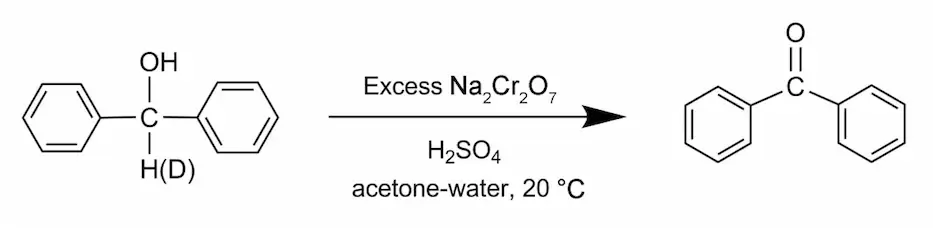
2-A6) Let be the initial concentration of undeuterated or deuterated diphenylmethanol, and let be its concentration at time t. The experiment gives the two curves below, from which the first-order reaction rate constants can be obtained
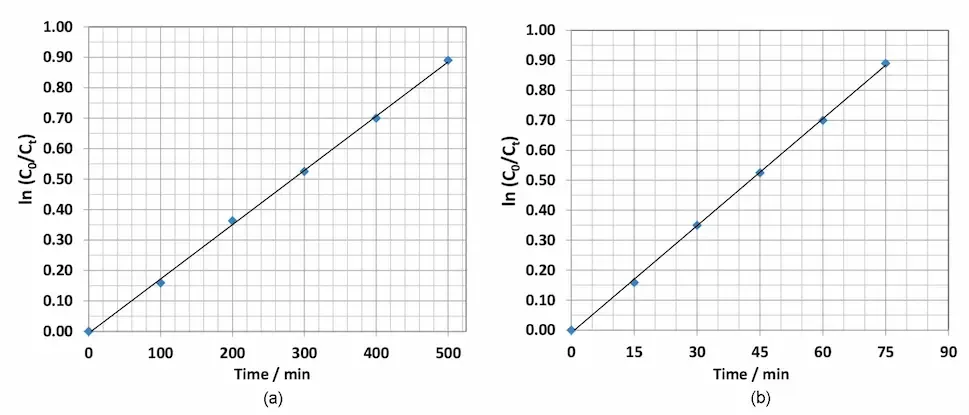
Which graph represents the oxidation of undeuterated diphenylmethanol? Which graph represents the oxidation of deuterated diphenylmethanol? Select your answers
Oxidation of undeuterated diphenylmethanol ⃝ Figure a ⃝ Figure b
Oxidation of deuterated diphenylmethanol ⃝ Figure a ⃝ Figure b
Solution
The rate in Figure b is clearly greater than that in Figure a
The oxidation of undeuterated diphenylmethanol is shown in Figure b
The oxidation of deuterated diphenylmethanol is shown in Figure a
2-A7) Using the graphs in 2-A6), calculate for this reaction (in ) and /
Solution
The first-order rate constant is given by
The steps are omitted; the results are
2-A8) Assume that the reaction mechanism is as follows:
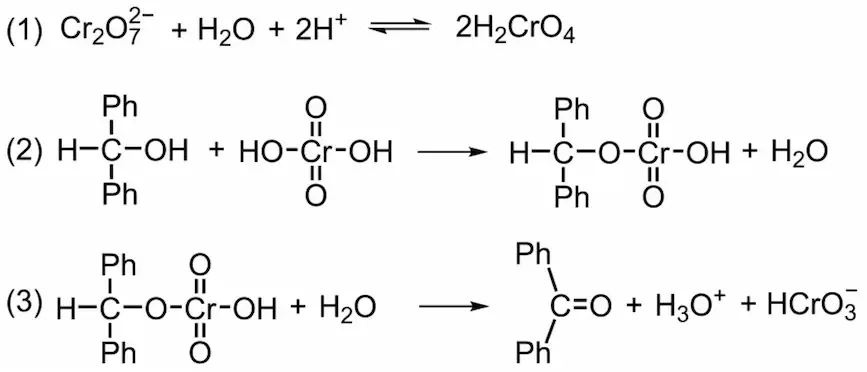
Based on the information given in 2-A6) and 2-A7), determine which step is the rate-determining step. Select your answer
⃝ Step (1)
⃝ Step (2)
⃝ Step (3)
Solution
There is nothing more to say, this should be obvious
Deuterated Compounds
The chemical formula of heavy water is written as
Compounds in which H atoms are replaced by D atoms have many uses, such as solvents for spectroscopy (think: why?)
Replacing H with D can significantly affect the properties of a compound Their different boiling points indicate differences in intermolecular hydrogen bonding: hydrogen bonds in are stronger than those in
An important industrial use of is as a moderator in nuclear reactors. D has a much lower neutron capture cross section than H, so can reduce the energy of fast neutrons produced by fission without appreciably reducing the neutron flux
Many fully or partially deuterated compounds are commercially available. The degree of deuterium labeling can be determined by mass spectrometry, density measurement (after conversion to water), or infrared spectroscopy
The separation of D from H in water is achieved by electrolysis. When an aqueous NaOH solution (at natural isotopic abundance) is electrolyzed using nickel electrodes, the separation factor is approximately 6. The choice of electrode is crucial to increasing this ratio